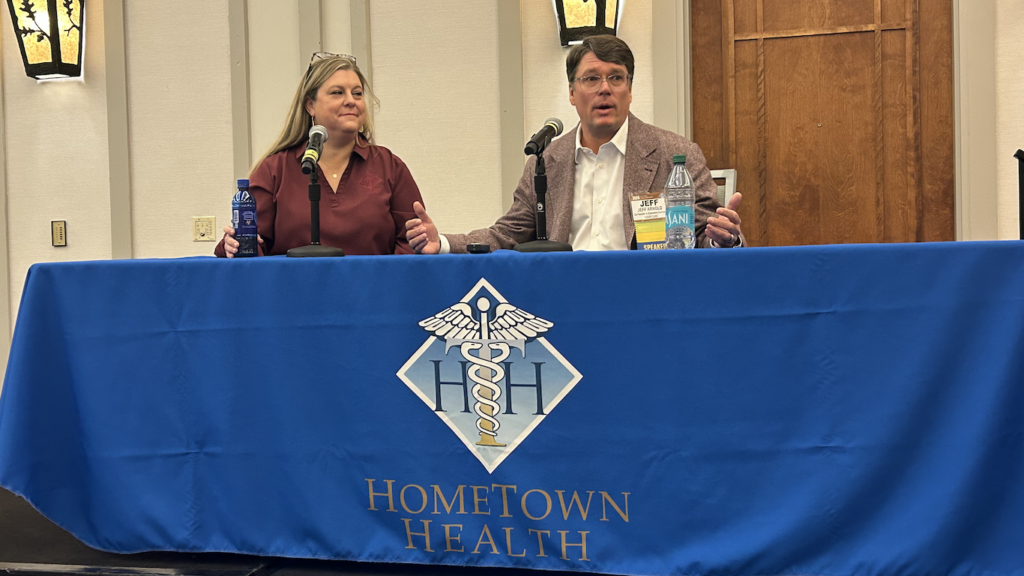
I recently joined HomeTown Health COO Kristy Thomson for a fireside chat called “Keeping Care Local: How Innovation Can Fortify Rural Hospitals and the Communities They Serve” on the last morning of HomeTown Health’s Fall Conference
Rural hospital leaders from across Georgia were asking the right questions, and I left more convinced than ever that we can transform rural health together. Here’s what I shared, and what I heard.
Technology only works when it earns trust
My first company, founded in 1994, monitored patients’ hearts remotely. It taught me that the technology mattered less than the relationship with the patient. That relationship drove follow-through, follow-through drove results, and results earned the doctor’s trust.
WebMD came a few years later, before Google. Nobody stumbled onto it. It grew because people told each other about it.
Those lessons are the foundation of AskMD by Sharecare. Healthcare is still fragmented, and information people can act on is still hard to find. What’s changed is that nearly everyone carries a smartphone. Built responsibly, with the right clinical guardrails and security protocols, AI is the biggest opportunity I’ve seen in my lifetime to help people make better health decisions.
Not just information. Action.
Georgians already take their health questions to search engines and chatbots. But do those answers lead to a real next step? That’s where AskMD comes in, adding what general search can’t:
- Evidence-based guidance, with citations clinical partners can check
- Insurance awareness, including copays, deductibles, and prior authorizations
- Health records pulled in through national data networks, with no burden on the hospital
- Doctor matching based on network, proximity, and availability
- Well-being measured down to the zip code, to help people move from episodic care to day-to-day health
AskMD doesn’t diagnose or change medications. It helps people understand what’s going on and guides them to the right level of care, in partnership with their doctor.
During the session, we showed a demo featuring Marie, a Medicaid member in rural Georgia with several ER visits this year. When she asks whether a new symptom means another trip, AskMD checks for warning signs first. With none present, it helps her find nearby doctors who accept her Medicaid plan, including a clinic with Saturday hours, and helps her prepare for a call with them. An avoidable ER visit becomes a primary care visit in her own community.
The local choice should be the first choice
The question that stayed with me came from a hospital leader who sees patients steered to urban systems, even when local care costs less: How can a rural hospital trust AskMD to point people to the hospital or clinic down the road?
My answer: AskMD is designed around proximity, and we believe the local choice is the first choice when it’s appropriate. Attribution rules are still being defined, but we’re focused on getting people to the right place and bringing more price transparency into the experience. Hospital partners also get population dashboards built on de-identified data.
There’s a first-mover advantage, too. When a hospital introduces someone to AskMD, that relationship starts with the local clinician.
Taking burden off, not adding to it
Rural hospital leaders are short on time, IT budgets are tight, and many systems run on older EHRs. So AskMD removes three burdens:
- Cost: Fully funded through the GREAT Health Program, AskMD comes at no cost to rural hospitals in Georgia
- Implementation: People connect their own insurance and health records, so there’s nothing new for a local hospital’s team to integrate
- Preparation: Patients arrive better prepared, with conversation summaries to share with their clinic or doctor
We were also among the first companies to join the CMS Health Tech Ecosystem and its effort to “kill the clipboard.” Once someone verifies their identity and connects their insurance and records, AskMD can generate a QR code that summarizes their information for faster check-in. Even if the clipboard sticks around, people are empowered to fill it out accurately because their information is already in the palm of their hand.
Interoperability with older EHRs came up, too. No single fix solves it. Person-driven data access, direct connections, national standards, and CMS implementation guides all play a role.
Think of us as your activation partner
Sharecare has worked in Georgia for well over a decade. Since 2017, that work has included state employees, employees of some of Georgia’s largest employers, and Medicaid members statewide. Today, more than a million Georgians are on our platform.
We’re building awareness through search and AI engines, partners who already reach Georgians, local health fairs, places of worship, and sports partnerships like ours with the Atlanta Hawks. But the physician-patient bond is the most important bond in healthcare. That’s why we want people to find AskMD through their local hospital.
Why Georgia, and why now
There are always reasons to say no, especially for busy rural hospitals. What I’ve found in Georgia, again and again, is a willingness to do better for the communities they serve. That’s why we keep investing here, and why we’re starting to extend this work to neighboring states across the Southeast.
Near the end of the session, someone asked how I feel about AI in healthcare. I think it’s the most empowering shift of my career. Concerns about privacy and accuracy are real, and we have to be responsible about guardrails. But the advice I give my kids applies to all of us: use it, stay on top of it, and don’t be afraid of it.
Thank you to HomeTown Health and Kristy for the invitation, and to every rural hospital leader keeping care close to home in Georgia.