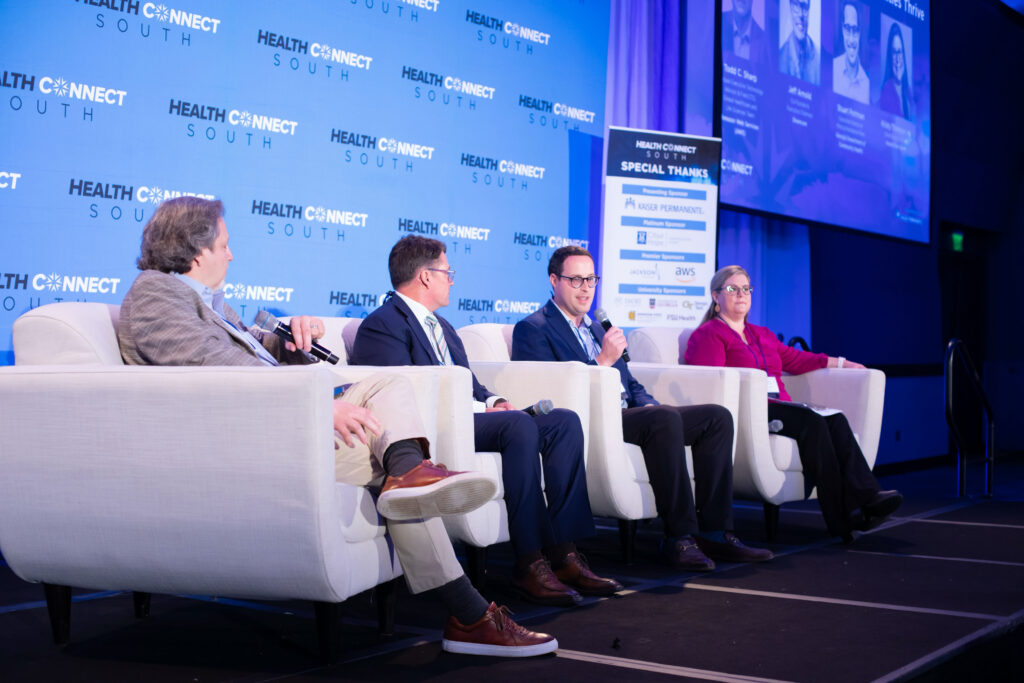
Pictured L to R: Todd Sharp (AWS), Jeff Arnold (Sharecare), Stuart Portman (Georgia Medicaid), and Kristy Thomson (HomeTown Health)
A year ago at Health Connect South, I listened to CMS Administrator Dr. Mehmet Oz describe a new health tech ecosystem for the country. That conversation sparked an exciting question: could Georgia lead the nation as the demonstration state for rural health transformation?
This year, I got to help answer that question on stage at the 13th annual gathering of Health Connect South. I was joined by Stuart Portman, Georgia’s Medicaid director and lead for the Georgia Rural Enhancement and Transformation of Health (GREAT Health) Program, and Kristy Thomson, chief operating officer of HomeTown Health, while Todd Sharp of Amazon Web Services moderated. Our topic explored remodeling healthcare’s digital future so rural and underserved communities can thrive.
What struck me most is how much has changed in 12 months. Capital has been allocated. The strategy is in place. Rural hospitals and clinicians are helping shape the framework. And infrastructure that didn’t exist a year ago is live today.
A plan built on real data
Stuart walked the room through Georgia’s approach to the federal Rural Health Transformation Program, a five-year, $50B investment created by last year’s federal legislation. Georgia made a bold choice: if these funds are going to make a lasting difference in our state, they have to stabilize rural hospitals financially, not fund one-off projects.
So the state aligned its program with the CMS AHEAD model. AHEAD is a value-based model that brings Medicare, Medicaid, and commercial coverage together into a single global budget. Of the 93 eligible rural and referral hospitals in Georgia, 87 volunteered for a three-year pre-implementation period. Each one completed technical, financial, and operational readiness assessments. The state is now connecting to every participating hospital’s EMR so it can show each one exactly how it would perform under the model.
As Stuart put it, the only way this succeeds is with a personalized understanding of how care can be delivered, and technology to help deliver it.
Why consumer engagement is built into the model
This is where AskMD by Sharecare comes in, and Stuart said it better than I could: Value-based care depends on population health, and population health depends on consumer engagement. That’s why Georgia funded a dedicated consumer engagement component as a core part of the program. Every hospital that participates will have access to AskMD across payors.
“As a patient, as a consumer of health services, they’re the focus,” Stuart said. “Their engagement is the only way that we can succeed.”
I’ve spent my career trying to give people better access to health information. What’s different now is that we can do it in a shared environment, with shared goals. When the state, hospitals, clinicians, and people in the community are all working toward the same outcomes, you close the gaps and get real results.
Removing the fear from getting care
Kristy brought the conversation home with a story I keep thinking about. She has been talking with farmers across rural Georgia. Many of them avoid the doctor because they’ve heard the stories about $2,500 bills. Virtual care exists, but many people don’t know how to reach it.
She described what it would mean to put a tool in their hands that helps them understand where to go, what their coverage looks like, and what to expect before they make the call. In her words, it could eliminate “the barrier of fear to go to the doctor because we can’t afford it.” It also makes everyone’s job a little easier, from the rural hospital’s front desk to the care team.
That is exactly why we built AskMD to be insurance-aware. When I ask a question about my back pain, the guidance should reflect my coverage, my history, and my options.
Taking the vetting burden off rural hospitals
Kristy also made a point that every technology company serving rural health should hear.
A rural hospital doesn’t have a large IT department or an innovation team. It often has a CEO, a CFO, and maybe a CNO who handle everything from grants to staffing. For many of them, the responsible first step with AI has been governance, which sometimes means telling staff not to use it at all.
Because AskMD arrives already vetted and supported at the state level, it isn’t one more tool they have to evaluate on their own. Kristy said it “skips us like 200 steps ahead,” so hospital leaders can focus on the barriers that matter locally. Todd added that running in an environment with processes that have been certified for HIPAA and HITRUST is a real differentiator in this setting.
Technology that gets out of the way
Todd raised a concern I hear from physicians all the time: every new device threatens to come between the clinician and the patient. Our goal is the opposite. AskMD should help people arrive better prepared, so the time they spend face-to-face with their care team counts.
I shared a recent real-life example from an AskMD user whose father had two concerning medical events within 24 hours, including seizures. She described his symptoms to AskMD and it responded with evidence-informed guidance, fully cited, and made it clear that the right next step was to get him to the ER. While there, she continued using AskMD to organize her thoughts and prepare questions, ultimately prompting her to advocate for a neurology consult, which resulted in the root issue being identified and treated during the ER visit.
AskMD didn’t make any clinical decisions that day. It helped a worried daughter be a better partner to her father’s care team in a critical moment.
Kristy then gave me a new challenge: help people find their way inside a rural hospital as easily as they find aisle five at the hardware store. Challenge accepted.
The roadmap is already on the wall
When we first joined the CMS Health Tech Ecosystem, there were about 60 people in the room. At the most recent CMS gathering, there were 1,200. Organizations that once blocked data are now collaborating around shared interoperability standards. “Kill the clipboard” is becoming real. Work on scheduling and pharmacy price transparency is moving quickly.
At that last CMS meeting, they showed a slide listing everything accomplished over the past year, with green checkmarks down one side and a new set of goals down the other. When I saw it, I thought: that’s my product roadmap. Our job is to turn that hard work into an experience people trust, one that helps them manage their own health and prepare for time with their clinicians.
Where you come in
Todd closed by asking what the audience could do to be part of this. My answer is simple. Download AskMD. Verify your identity with CLEAR, connect your health records and insurance, ask a question, and see whether you get a personalized plan.
If you’re a physician, ask yourself afterward: would this help my patients, and would it help the time I have with them? If you’re an employer anywhere in Georgia, we’ll give you a toolkit that makes it easy to share AskMD with your team. It benefits your people, your business, and the rural hospitals and communities that serve them.
Kristy summed it up well: there are enough big ideas here to keep us busy for five years. But as long as we collaborate and support each other as we move from theoretical to practical, change is coming. I believe it, too. Georgia is showing the rest of the country what’s possible.