At Sharecare, marketing and brand strategy play a critical role in how the company connects with partners, clients, and the people we serve.
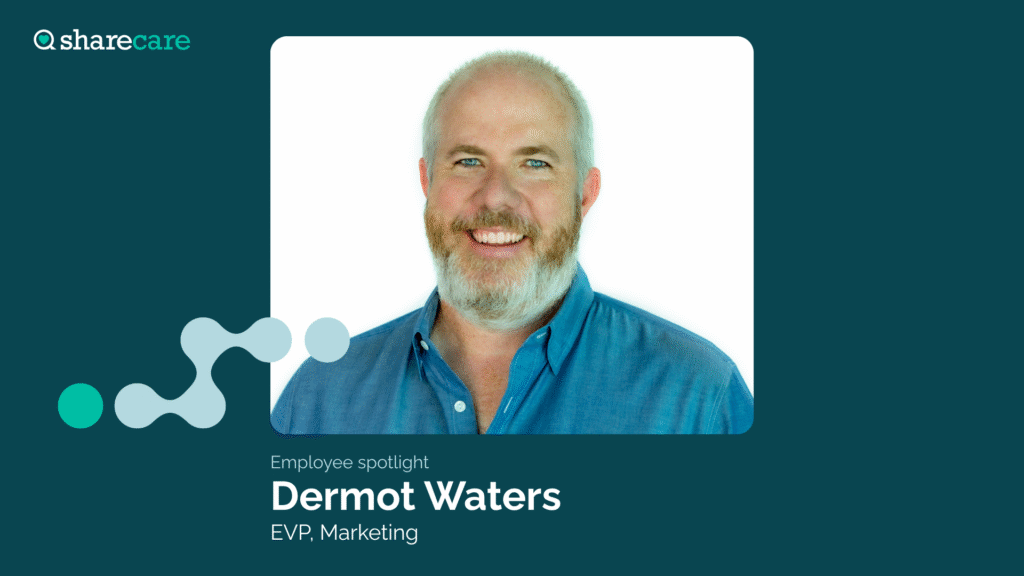
This month’s Executive Spotlight features Dermot Waters, EVP of marketing, who leads efforts to shape Sharecare’s brand strategy and how we articulate the value proposition of company’s products and experiences across various audiences. Over Sharecare’s lifetime, Dermot’s role has evolved alongside it while his efforts have always been central to translating Sharecare’s vision into a cohesive, consistent story.
Originally from Ireland (and, as he’d quickly point out, a firm defender of “St. Patrick’s Day” shorthand branding as “Paddy’s Day” and NOT “St. Patty’s”), he brings a creative yet methodical approach shaped both by his family and early career experiences that continue to influence how he works today.
Before joining Sharecare, Dermot spent more than a decade at CNN, where he led product for digital platforms and worked on major live breaking news events that reached millions of people in real time. He joined Sharecare in its very early stages, building out the company’s original product organization before formally transitioning into product marketing and brand strategy.
In conversation with Jen Martin Hall, EVP of corporate communications (who he’s worked with closely for nearly two decades, starting at CNN), Dermot reflects on the evolution of Sharecare and why the work ultimately comes down to a simple yet complex principle: helping people navigate their health with clarity, confidence, and trust.
Jen: Your title covers a lot of ground — how do you describe what you actually do?
Dermot: At a high level, I oversee marketing across the organization, and there are a lot of incredible employees that help us execute on that, across our business units. But from a brand perspective, I view myself as the ombudsman — not just the protector of the brand, but the ambassador. It’s about how we tie everything together and represent Sharecare as a whole and across all the products we offer.
Jen: Marketing can mean a lot of different things. What does it mean at Sharecare?
Dermot: I always ask people that same question in job interviews, what “marketing” means to them. Because there’s no wrong answer. It’s such a broad term that can mean a lot of different things across a lot of different marketing disciplines. At Sharecare, we really span all of those possibilities. We’re a B2B company, but we’re also direct-to-consumers or what I prefer to call “direct-to-person.” I hate calling people “users” or “consumers.” It feels impersonal. Ultimately, it’s people who are using our products and services, and when we think of them as people, it helps us build better products and solutions to serve them.
As far as the function of marketing at Sharecare, we think about it in layers. There’s growth marketing; bringing in new clients and partners. Then engagement marketing; how we actually connect with the populations – the people – we serve. And then product marketing, or how we talk about our platforms, solutions, and services across the whole of the company. But underlying all of that, marketing is really about perspective, and putting ourselves in the mindset of the person we’re trying to reach, so that we actually connect with those constituents in a meaningful way.
Jen: I think that’s what stands out to me. That mindshift from “users” to “people” really changes how teams at Sharecare approach everything.
You started your career in product. What led you to Sharecare?
Dermot: Before Sharecare, I was the head of product for CNN Digital. I started as what was called a webmaster at the time, and we literally hand-coded HTML pages for every article and FTP’d them to the servers… this was before any content management systems existed. Over time, I built out the product function and worked on everything from CNN.com to building the world’s first news apps for the iPhone and iPad to bringing major live, breaking news events to the internet versus just television. At the time, that was a novel concept.
One of the things I always loved was that the work reached millions of people instantly and informed their world view and impacted their daily lives.
That’s what drew me to Sharecare. It wasn’t just the potential scale, it was the idea that you could help people live healthier lives and manage their health in a more effective way. That was always a motivating factor for me.
Jen: Can you tell us a little more about your time at CNN?
I worked on six elections while I was there, including the Bush-Gore election, the final decision which took over a month to finalize thanks to “dangling chads” (IYKYK). I also will never forget working for CNN on 9/11, when the entire internet essentially crashed under the traffic. We all were scared and confused and terrified like the rest of the country – but we had a job to do; it was our job to tell the world what was happening. So in an instant, we stripped everything back on CNN.com and rebuilt the homepage line by line — starting with just headlines on a white page, and then adding more back as the internet’s bandwidth began to catch up. It’s hard to call that a proud moment, but it was incredibly impactful to be part of.
And then during the Obama inauguration, we built a live online experience that combined the video stream of that historic event with real-time Facebook updates. At the time, it was the biggest livestream event ever — we actually maxed out the internet that day, too, but for much different reasons than we did on 9/11.
Jen: How has your role evolved since joining Sharecare?
Dermot: I originally came in as the head of product and built the product team around the Sharecare platform in its earliest form. Over time, I found myself spending more time working with Jeff and Dawn to translate the vision into something more tangible; into a story people (especially investors in those earlier days) could understand and rally around. As that became a bigger and bigger part of my role, I shifted more into marketing, brand, and design, but I’ve always kept that product mindset. There’s not really a clean line between those things for me. It’s always been about building, whether that’s a product or a story.
Jen: Has your personal experience with healthcare shaped how you think about this work?
Dermot: Absolutely. Healthcare is incredibly personal. It’s also incredibly hard to navigate, even for people who work in it. My teenaged daughter has faced a lot of health challenges over the last year. In 2025 alone, she spent about 45 days in the hospital and had multiple surgeries. And even for people who are so immersed in healthcare, it was still very difficult to navigate — dealing with providers, insurance, and everything that comes with it.
Going through that while we were actively building AskMD really reinforced why we’re doing this. We want to help people make sense of their health and access their information, understand it, and feel confident they’re getting the right care. It’s not easy and it shouldn’t be as hard as it is.
What’s something people might not know about you?
Dermot: I was born in Ireland, and I still have a really strong connection with my heritage.
Growing up, every summer, the day after school ended, we’d get on a plane and go back home to Ireland for about two and a half months. We’d live on my grandparents’ farm, and then come straight back and go into the next school year. At the time, I didn’t always appreciate it. I felt like I was missing things here. But looking back, it was incredible. It made me really close with my family, and it shaped a lot of who I am.
There’s also a lot of creativity in my family. My father was a carpet designer in a small town in Ireland, and he literally painted carpet patterns pixel by pixel, by hand, for decades. Ultimately, that’s what brought us to the U.S. So even though I didn’t go the traditional creative route (I majored in economics), that artistic foundation was always there. That mix of creativity and craftsmanship, I think about that a lot in the work I do now.
Jen: Sharecare has grown significantly over the years. How do you keep everything feeling connected?
Dermot: I use this analogy all the time, that we’re writing chapters that all need to fit in the same book. Each product or solution can have its own story and its own arc, but it has to fit into the larger Sharecare story. Otherwise, it feels disconnected.
That’s a big part of my job, making sure everything ties together. Whether it’s a product, an event, or an advertisement you see out in the world, I want it to feel like it’s coming from the same place. It’s really hard to do, especially at the pace we move. But it’s incredibly important.
Jen: What are some of the biggest challenges in your role?
Dermot: At Sharecare, we move really fast. That’s part of our DNA. We’ve always been a company that’s innovative and moves quickly. But as we’ve grown, it’s become harder to make sure everyone is operating from the same playbook. From a brand perspective, that’s the challenge — making sure people have the tools and understanding to do their jobs well without slowing things down. We don’t need perfect to get in the way of progress. But at the same time, we want to be intentional in how we show up.
Jen: A lot of teams are starting to use AI more in their day-to-day work. What advice would you give to people figuring out how to use it effectively?
Dermot: Ultimately, it’s not about doing more. It’s about doing things better – and if we can do that more quickly without compromising quality, I’m all in. AI should enhance human creativity, not replace it. The ideas and the voice still have to come from people, especially in healthcare where trust and empathy matter.
Where AI helps is in how we work. It removes friction, getting to a starting point faster, structuring ideas, and freeing up time for more meaningful thinking. It also expands creativity. Instead of starting from a blank page, you can explore and iterate more quickly. But we still have to be intentional. AI doesn’t replace judgment. At the end of the day, we’re responsible for making sure everything reflects who we really are; not an algorithm.